How many backlinks do I need?
There is no fixed number of backlinks you need, because it depends on who you compete with, so the honest target is enough real referring domains to match the pages already ranking for your search.
At a glance
- No universal number exists
- Your competitors set the bar
- Count linking sites, not total links
- Quality and relevance beat volume
Why There Is No Single Number
Links are one of many things search engines weigh. Google says it uses links as a signal of how relevant a page is, and its guide to how Search works says it returns the results most relevant to each search. Content, relevance, page speed, location and how well a page answers the search all count too. So the number of links you need changes with the search you are trying to win.
A plumber in a small town may rank with a handful of good local links. A national insurance site may need thousands of linking sites to even reach page two. Both answers are right for their market. The only useful question is how many links you need for your search, against your competitors.
How to Work Out Your Own Target
This does not take long.
- Pick one search you want to win. Use the words a customer would type, like the service and the city.
- Note the sites on page one. Skip the giant directories and marketplaces you cannot beat on links. Focus on businesses like yours.
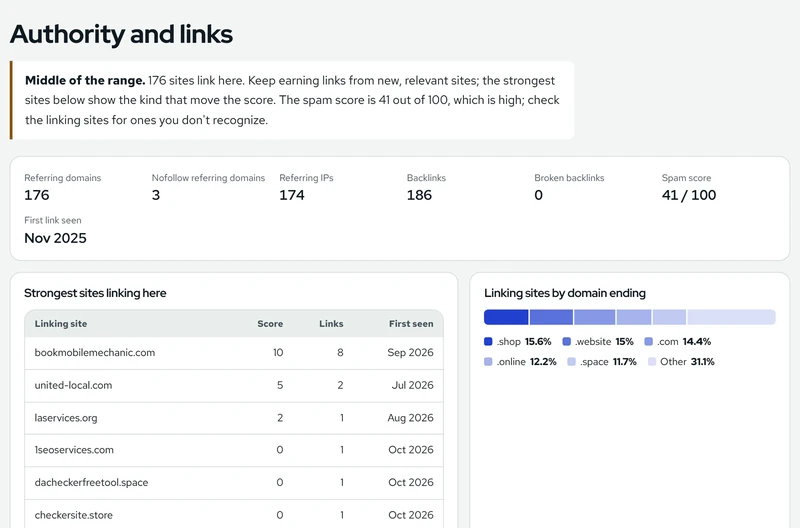
- Audit each one. Run a free audit on each site and write down its referring domains and its PageRanker Score.
- Audit your own site. Put your numbers next to theirs.
The middle of that group is a fair first target. Here is a worked example. If the top three sites have 40 to 60 referring domains and you have 8, the gap is 32 to 52 linking sites. If you already match them, links are probably not what is holding you back, and you should look at content and pages instead. On the Growth plan you can put two sites side by side in one report.
Count Sites, Not Links
When you compare, use referring domains, not total backlinks. One site that links to you from every page can add thousands of backlinks and still only count once. Our guide on what a referring domain is explains why the count of linking sites is the fairer number.
Quality Changes the Math
Two sites with the same number of referring domains can have very different strength. A few links from respected, related sites can outweigh dozens of links from weak or unrelated ones.
- Relevant links come from sites in your field or your area.
- Strong links come from sites that many others link to.
- Followed links are not tagged nofollow, sponsored or user generated.
- Natural links sit inside real content, not in pages built only to hold links.
That is why the PageRanker Score looks at how strong the linking sites are, not just how many there are, and why it cuts back sites whose links come mostly from spam networks.
Links Are Not Always the Problem
Before you chase links, make sure the basics are in place. A page that does not match the search, loads slowly on a phone, or has a weak title will struggle no matter how many links point at it.
The audit checks those too. The crawl lists broken pages, missing titles and duplicate content, and the speed test grades mobile load. The page checker shows whether your target words actually appear in the title, headings and text of the page you want to rank. Fix those first. They cost nothing but time.
How Fast Should You Add Links?
There is no safe speed to aim for. Real links tend to arrive in an uneven way, a few at a time, sometimes in a burst when something you publish gets shared. What looks odd is a sudden pile of links from unrelated, low quality sites. Google's spam policies list buying or selling links for ranking as link spam, and that sudden pile is the trail those schemes leave.
Focus on earning links you would be glad to show a customer. Trade groups, local partners, suppliers, sponsors, local news and useful guides are the usual places to start.
Track the Gap Over Time
Your target is not fixed. Competitors earn links too, and new sites show up on page one. Run the same comparison every month or two. Write down your referring domains, your score and theirs in one place.
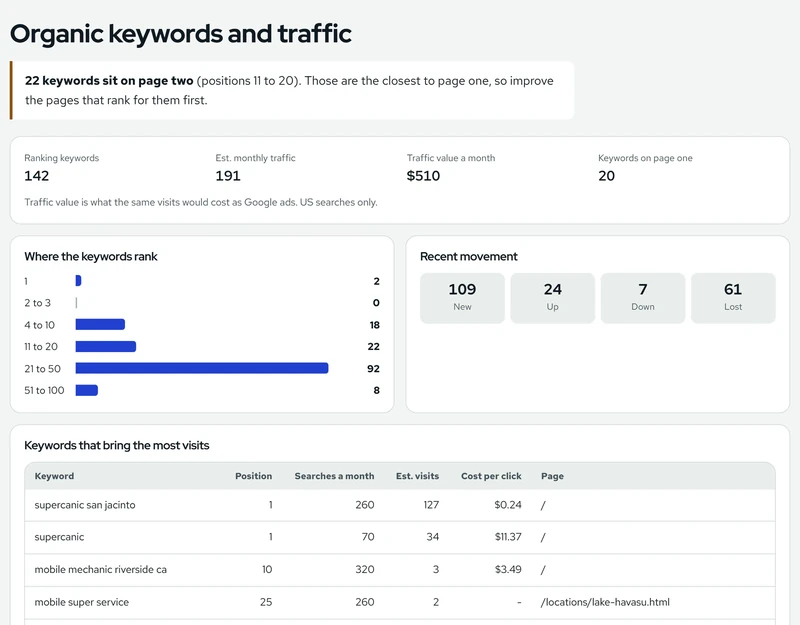
Watch for two things. Is the gap getting smaller? And are your rankings for the search moving at the same time? If links go up and rankings do not move, the problem is likely on the page. If both move together, keep going. A paid plan lets you save the sites you track so the next check takes a minute.
Sources
- Google Search Central, link best practices, opened October 17, 2026
- Google Search Central, how Google Search works, opened October 17, 2026
- Google Search Central, qualify your outbound links, opened October 17, 2026
- Google Search Central, spam policies, opened October 17, 2026
Common Questions
Can I rank with no backlinks?
Sometimes, for searches with little competition, such as a very specific question or a small local market. For most competitive searches, pages with no links struggle to reach page one.
Is it better to have more backlinks or more referring domains?
More referring domains. Many different sites linking to you is a stronger signal than many links from one site.
Should I buy backlinks?
Paid links meant to pass ranking value go against Google's spam policies, and cheap link packages usually come from networks built only to sell links. Earned links last longer and carry less risk.
How do I see how many backlinks a competitor has?
Run an audit on their domain. The report shows their referring domains, backlinks and strongest linking sites, using only public link data.
See where your own site stands. Links, Google rankings, a site crawl, mobile speed and your home page, checked in one report.
Run free audit